Everyone who watched television during the ’90s remembers Frasier. The snooty but loveable psychiatrist Dr. Frasier Crane was first seen on the hit TV show Cheers and later wound up being the best candidate for a spinoff once the almighty Cheers wrapped up production in 1992.
Chock-full of intelligent wit, slapstick comedy, a healthy dose of sitcom clichés, and a surprising amount of depth, Frasier very quickly took the television world by storm.
By the time Frasier ended on its 11th season in 2004, the show had achieved 318 nominations for a variety of industry awards, including…
Because many people have been on the lookout for another great show to binge, I thought I’d round up the 10 best Frasier episodes for you to check out and enjoy!
Special thanks to the group on the Frasier subreddit for assisting me with this!
When Frasier’s father Martin has a female neighbor named Elaine over for dinner, one thing leads to another, and Elaine finds herself still at the Crane residence in time for breakfast with the family the next morning.
Already a bit uncomfortable with the nature of her situation, Elaine gets more than she bargains for when Frasier catches on to what happened.
On the Best Frasier Episodes List Because…
Frasier is taken completely off-guard by “Plain Old Dad” and his new breakfast companion. Although Frasier has the best of intentions, as he converses with Elaine and Martin, his comments inadvertently become increasingly sexual in nature.
Frasier’s wild attempts to backpedal and correct himself once he realizes how he’s coming across is what really makes the breakfast scene incredibly hilarious.
Following a verbal mishap involving Daphne’s freshly-cooked “Bangers and Mash”, the scene ends (fittingly, in my opinion) with a snarky exchange between Frasier and Daphne:
Frasier: You couldn’t have served bacon?
Daphne: ME!? The way YOU were carrying on, I think we can be thankful I didn’t make Toad-in-a-Hole!
Frasier’s psychiatrist younger brother Dr. Niles Crane has landed a book deal with a major publishing company.
However, Niles is in a bind- the idea he had previously pitched to the publishing company has already been taken, and he’s having trouble coming up with a new concept to pitch.
When Frasier meets Niles and Niles’ contact from the publishing company, Sam Tanaka, at Cafe Nervosa, Sam mentions offhand that a book about two psychiatrist brothers could do very well.
Niles jumps at the opportunity, telling Sam that was exactly the idea he and Frasier had intended to pitch. Frasier is therefore obligated to write the book with Niles.
On the Best Frasier Episodes List Because…
When Niles tries to talk Frasier into writing the book with him (stating that it has “always been my dream to walk into a library, check the card catalog, and see my name under ‘Mental Illness'”), Frasier is initially reluctant.
But Niles reminds Frasier how much fun they had had writing the Spring Musical for their prep school when they were boys, using an old song and dance number they’d written…
The last episode of the first season, “My Coffee With Niles” takes place entirely at Café Nervosa.
Frasier and Niles meet up for coffee, and after several minutes of navigating the overcrowded café in search of a table, Niles asks Frasier one seemingly simple, yet also complex, question:
“Now that Chapter Two of your life is in full swing, would you mind if I asked you something? Are you happy?”
Frasier is taken aback by the nature of the question, and purposely stalls for time to avoid responding right away.
Fortunately, this isn’t difficult- every time Frasier attempts to answer this question, other random characters manage to interrupt Frasier and Niles’ conversation with their own assortment of personal issues.
On the Best Frasier Episodes List Because…
This episode is particularly exceptional to me, because even with minimal scenery and plot changes, the depth of the overall conversation between Frasier and Niles keeps the viewer engaged.
In my opinion, the episode is a credit to the show’s talented writers.
There is also an amazing moment in this episode. Actor David Hyde Pierce, who plays Niles Crane, is a gay man. We didn’t know that then.
But at one point, Pierce breaks the fourth wall by sneaking a very subtle smirk directly at the camera during a scene in which Frasier jokes that Niles must be a gay man, that his life with his wife Maris has been a lie and he should’ve come out of the closet years ago.
When Niles is invited to a swanky society ball following his separation from his wife, Maris, he quickly finds himself a date.
However, upon discovering that couples would most likely be expected to dance, Niles panics. He’s never learned how to dance, so Daphne volunteers to give him dance lessons.
Niles (who has harbored secret feelings for Daphne since they first met) very much enjoys the lessons, until his father Martin cautions him about the things that can happen when the lights are low and one is caught in the heat of the moment.
On the eve of the dance, Niles’ date cancels. Daphne, eager for an elegant evening out, offers to take her place as Niles’ date.
When the two of them hit the dance floor and a Tango dance number begins to play, Niles and Daphne put on a performance that would make even Fred and Ginger green with envy.
On the Best Frasier Episodes List Because…
This episode is the first time Niles Crane really comes out of his shell, and begins to explore his feelings for Daphne on a much deeper level.
David Hyde Pierce and Jane Leeves did an amazing job filming this scene. Learning those dance steps must have been very complicated, and as someone who is 6’6 (and the very person with whom “breakdancing” has become synonymous in the most literal sense of the term), I have to appreciate the amount of work and dedication that surely went into the choreography of the Tango scene.
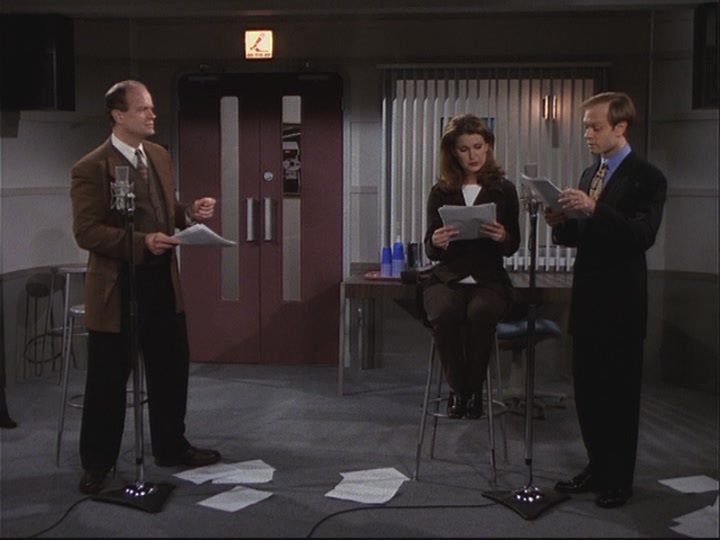
Frasier has been chosen to direct an old-time radio “Whodunnit”-style drama for KACL. However, his tendency to get too involved as a director and his compulsive perfectionism soon begin to show.
From rehearsal to the day of the performance, Frasier’s overdirecting is driving his fellow cast members crazy.
Everything starts to go downhill as soon as the production begins, with Frasier’s producer Roz suffering from a temporary speech impediment (a result of her dentist being too liberal with the Novocain during her appointment earlier that day) and Niles stuck playing several different voice parts as a result of another cast member quitting the production in a rage during rehearsal.
On the Best Frasier Episodes List Because…
This episode is one of the best because as the viewer, it is absolutely hilarious to watch the production slowly disintegrate before Frasier’s eyes and his valiant attempts to save it. Plus, Niles’ choices for his numerous voices are hysterical.
When Frasier gets a free ski weekend in the mountains from his producer Roz, he invites his family to join him. The weekend comes complete with scenery, a great cabin, and an in-house former Olympic ski champion to give them skiing lessons.
The newly-separated Niles is desperate for Daphne to join them (she can’t because she had made plans with her friend, lingerie model Annie, for her birthday) and invites Annie along so that Daphne can come.
Once the Crane family (plus Annie) reaches the cabin, they meet their French ski instructor, Guy, who immediately develops a crush on Niles.
On the Best Frasier Episodes List Because…
I am usually not a huge fan of the Sitcom Farce. Frasier, I think, relied quite a bit on that, and the big, honking, two-week-long misunderstandings of cosmic proportions got to be tiresome for me after a while.
However, this episode was different for some reason. It had to be the reactions of the characters to the sexually-charged insanity that was unfolding in the ski lodge.
Niles wanted Daphne, Daphne wanted Guy, Guy wanted Niles, Annie wanted Niles, and Frasier wanted Annie.
The writing and the acting were just top-notch in this episode, and I think that’s what made it as good as it was.
#7: Roz and the Schnoz (S5, Ep. 21)
A few episodes prior to this one, Roz Doyle had found out she was pregnant by a young man with whom she had had a brief fling.
While staying with Frasier for a few days, Roz receives a call from the young man’s mother, Paula Garrett, asking if it would be possible to meet Roz before she and her husband leave for Paris.
Frasier has the Garretts over to his condo, with Niles, Daphne, and Martin also in attendance.
The Garretts prove to be kind, supportive people…but their overlarge noses are the cause of much hilarity for everyone in the Crane household, and it is almost too much for them to bear.
On the Best Frasier Episodes List Because…
What makes “Roz and the Schnoz” such a great episode to me is the fact that five grown adults are struggling not to laugh at something as simple as large noses. And their reactions to unintentional nose puns by the Garretts add to the funniness of the episode.
#8: Something Borrowed, Something Blue Pt. 2 (S7, Ep. 24)
After Frasier inadvertently blurts out Niles’ secret to Daphne while under the influence of some powerful painkillers in Part 1, Daphne is stunned.
She is also very conflicted- she is already engaged to a kind and thoughtful man who loves her more than anything, while Niles is engaged to his plastic surgeon.
In this heartfelt episode, Daphne wrestles with her emotions on the eve of her own wedding, until she figures out that she is in fact in love with Niles too.
On the Best Frasier Episodes List Because…
“Something Borrowed, Something Blue Pt 2” isn’t necessarily the funniest Frasier episode, but it’s one that kind of tugs on the heartstrings just a bit.
After years of fantasizing about Daphne, Niles has moved on to another woman just as Daphne has her eyes opened to what he has been feeling for her all this time.
The fact that both Niles and Daphne are already in loving relationships with other people at the time of this revelation really lets the viewer know the magnitude of the situation, and does a very good job foreshadowing the difficulty of the road ahead for Niles and Daphne.
Frasier has been archenemies with his equally-pompous upstairs neighbor, Cam Winston (Brian Stokes Mitchell) since they first met.
But when Martin’s dog Eddie starts feeling under the weather, Cam’s mother Cora Winston (a veterinarian who is currently staying in the building with her son Cam) treats him.
In doing so, she becomes friendly with Martin, much to the chagrin of Frasier and Cam.
When Martin and Cora wonder aloud why Frasier and Cam hate each other so much (since they are actually very alike and have a lot in common), they decide to mess with Frasier and Cam’s heads by pretending they’re sleeping together.
Martin and Cora hope that this will force Frasier and Cam to get along, and therefore go to extreme lengths to fool the boys.
Their ruse is elaborate enough to convince Cam and Frasier that Martin and Cora are serious about each other, so they decide to roll up their sleeves and end their feud, “for the sake of our parents”.
On the Best Frasier Episodes List Because…
The reactions of Frasier and Cam to their parents’ “dating” are just priceless. They get very uncomfortable and very awkward, and the comedic timing of Kelsey Grammar and Brian Stokes Mitchell in this episode is impeccable.
Many Frasier episodes have lost their funny factor for me over the years, but this is one of the few that has me laughing hard every time I watch it. There aren’t many episodes that can pull this off.
While at Cafe Nervosa with his father and Niles, they meet Roz’s new boyfriend Barry. Barry is good looking and in very good physical shape…but a pronounced lisp, his mannerism, and his job as a womans wear buyer at Bidwells are enough to convince Frasier that Barry is gay and therefore lying to Roz.
Later that night, as Frasier and Niles are walking back from their squash club, they see Barry leave what appears to be a gay club called “Bad Billy’s”.
Frasier (who is currently wearing Niles’ considerably-smaller athletic shorts because his own had accidentally split during squash) goes into Bad Billy’s looking for Barry.
A listener of Frasier’s radio show recognizes him there and accuses Frasier of being gay on the air soon after. Everyone believes it because this (in typical Frasier fashion) was the result of several misunderstandings and miscommunications while Frasier was in Bad Billy’s waiting for Barry.
In this episode, Patrick Stewart makes a guest appearance as a world-renowned opera composer and celebrity named Alistair Burke, who finds himself very attracted to Frasier after he hears Frasier being “outed” on the air.
Burke immediately starts courting Frasier, and because it has always been Frasier’s dream to be “half of a power-couple”, he doesn’t immediately halt Burke’s advances.
On the Best Frasier Episodes List Because…
This episode does get uncomfortable at times, no question. But I consider the fact that Frasier’s zeal to be associated with the rich and famous, and the resultant clouding of his judgment about Alistair Burke’s romantic feelings toward him, to be very funny.
Plus, Patrick Stewart has never disappointed, no matter what role he plays. His background as a classically-trained actor really adds a lot to the quality of this episode.
Frequently Asked Questions (FAQs)
Why did Daphne leave Frasier Season 8?
Jane Leeves left to give birth to her first child in 1998, and both her pregnancy and her absence were written into the show as subplots (Daphne was ostensibly away at a spa/rehab center to manage her weight problem).
Why did they never show Maris on Frasier?
According to the writers, because the jokes describing Maris got increasingly more outlandish as the show went on, they decided to refrain from casting her part because they felt that no actress could accurately portray Maris’ almost sub-human characteristics. Therefore, her actual appearance was left ambiguous to the viewers and the show only offered teasing, fleeting glances of her (similar to Norm Peterson’s never-seen wife Vera on Cheers).
How many episodes are in each season of Frasier?
There are 24 episodes in each of the 11 seasons of Frasier, totaling 264 episodes.
Is Frasier coming back?
Yes, Kelsey Grammar has confirmed that the highly anticipated reboot of Frasier is slated to hit Paramount Plus in early 2022.
Hopefully, you enjoyed the stroll down TV-memory lane as much as I did with this list of the best Frasier episodes! The show won as many awards and accolades as it did because it did so many things right.
These days, you’d be hard-put to find another television show with the blend of intellectual wit, snarky sarcasm, and smart jokes that Frasier had in its repertoire.
I credit the show’s talented creators, Peter Casey, David Lee, and David Angell (who tragically died in the September 11th attacks before the show was completed) for making Frasier such a success, even though the sitcom landscape was already beginning to change.
I do call out many of the tired sitcom clichés that are part of the show, but overall, any show that still has me laughing after 20 years is, in my mind, one of the few television shows that have really stood the test of time.
Please share this post if you enjoyed it! Helps a lot 🙂
Unethical human experiments have taken place throughout history. But as mankind evolved, that sort of behavior gradually disappeared.
Or so we thought.
You see, the world we live in today is shaped by science, and most of those who carry out the experiments on which progress is based are bound by strict ethical codes.
We don’t like to think that cruel human experiments exist in the world we know today.
However, the truth is, even now, it is entirely possible for scientists and medical professionals to convince themselves that almost any amount of suffering and pain is morally justifiable if carried out in the name of scientific advancement and progress.
In other words, for the greater good.
Here are 16 particularly shameful instances of unethical human experiments in history!
1: Frederick the Great – What Language Should We Speak?
Frederick II, the Holy Roman Emperor, was something of a pioneer for his time. He was interested in science and discovery, spoke many languages, and managed to involve himself in the crusades without indulging in too much in the way of hatred of his enemies.
However, his scientific work was very much a product of that time period – he lived from 1194 to 1250 – and by modern standards would be considered astoundingly cruel.
Much of what we know about Fred’s attempts to understand the world comes from an Italian monk who couldn’t stand the man, so it’s possible that a large pinch of salt should be added to his accounts.
To discover more about the soul, he is said to have locked a man in a barrel. That man died, of course, but that was the point.
A small hole in his prison was supposed to allow his soul to fly out to be observed.
Another famous case saw two prisoners fed the same meal before being sent out on a hunt and to bed.
The purpose of the experiment was to see which activity best-aided digestion, the means for finding out was to disembowel both men and take a look.
Perhaps the most famous of Frederick’s experiments was his search for the “natural language” of humanity and God’s language.
To discover this, he started to lock up children with no human contact, allowing them to be fed and washed and so on but with no interaction with their wet nurses or foster parents.
The experiment failed – according to our monk – because the children suffered such misery.
I’m sure you’re hardly surprised to find the Nazis on this list. The whole collection of inhuman experiments could be filled with what they got up to, usually using subjects they considered racially inferior and thus utterly expendable in the service of the master race.
Of these experiments, one of the nastiest is the attempt to help German pilots to overcome hypothermia.
Working in concentration camps, Nazi doctors subjected prisoners either to hours in freezing water or to simply standing, naked, in the bitterly cold night air.
Soviet prisoners were a favorite, as the German army had experienced firsthand the brutal Russian winter during the Battle of Stalingrad. and they feared that their opponents might have been born to better withstand the cold.
Measurements were taken, and 100 people died in the process, all so that the SS’s top medical man at Dachau could make a report at a 1942 conference on the problem.
To the Nazis, medical experiments on living subjects were entirely within the ethics of their doctrine.
After the war, an exceptional Doctors’ Trial was held as part of the Nuremberg process, and 23 medical men were tried, and seven of them were sentenced to death.
If you have a strong stomach and a high tolerance for man’s inhumanity to his fellow man, read on to find out much more about this evil period in medical history.
#3: General Shirō Ishii and the Japanese Army’s Unit 731
Like the Nazis, the Japanese developed a nationalism based on racial superiority to see them try to grab the empire they believed they deserved during World War II.
Some Japanese scientists served the cause with a series of vile experiments on living subjects as research into biological weapons, or any other military projects that struck their fancy.
Among the subjects were those who fought against the Japanese imperial forces, Japanese criminals, and those arrested for “suspicious activities,” which reportedly included the old, the very young, and pregnant women.
China was considered a particularly fertile ground for this work. During World War II, the Japanese used Chinese captives for experiments.
The Japanese tested germ warfare weapons on the Chinese and looked for a cure for gangrene. Chinese POWs were infected with diseases, then cut up without an anesthetic to see how the condition developed.
Limbs were cut off in the same way or allowed to develop gangrene to see how flesh rotted and killed thousands of prisoners of war in the process.
.Epidemics started by the unit are believed to have killed about 400,000 Chinese civilians.
Weapons were also tested on live human subjects. POWs were buried alive, injected with seawater, starved to death, and frozen.
The man responsible for Unit 731, Dr. Shirō Ishii, managed to trade his experimental data for immunity from prosecution after the war, and it is alleged he went to work on the American biological warfare program.
He also converted to Christianity, and possibly ran a clinic in Japan offering free medical treatment.
#4: Dr. John Money and the Sex Change Experiment of David Reimer
The appalling experimenting of David Reimer was begun by accident. But the doctor who inflicted an unwanted sex change on him saw his patient not as a child in need of help, but as an experimental subject who might finally be able to help Dr. John Money answer one of life’s biggest questions- “nature versus nurture”, and its role in adolescent development.
David Reimer was a twin and, at just eight months, was sent to be circumcised. The operation went horribly wrong, and the boy’s penis was pretty much cut off.
Hoping to help their son, David’s parents took him to an expert in sexual identity called Dr. John Money.
Dr. Money told them to go through a sex-change operation and raise their son as a daughter.
Believing the noted physician’s advice, they went ahead. But Dr. Money saw David as insight into whether sexual identity came from genetics or surroundings – and an identical twin brother made him an ideal test subject.
David, predictably, had a miserable childhood. He was never truly able to accept that he wasn’t a boy.
At the same time, Dr. Money published papers on his “experiment,” which involved getting the twins to engage in sexual play from around the age of seven (he has also conducted research that suggests that not all pedophilia is terrible, but that’s another story).
Nuclear weapons had shown their destructive potential spectacularly with the ending of World War II in Japan, and following the end of the war, both the Soviet Union and the United States had nuclear arsenals at their disposal before long.
But how did the two superpowers learn more about these weapons and how to fight against them?
In 1954, in the Soviet Union, the answer was a massive experiment in which 45,000 men were sent to march through the area under a nuclear explosion.
The bomb used was about as powerful as both of those dropped on Japan, and the lucky village around which they were tested was Totskoye. The bomb blew up just 350 meters above the ground and only 8 miles from the village.
Then the troops were sent in.
The soldiers were told it was a routine training exercise, and that the explosion was a mock nuclear blast. They presumably didn’t notice that the man from the ministry, Georgy Zhukov, was ensconced in an underground bunker during the exercise.
Some locals were offered evacuation, but most were just left to get on with it.
Anyone who fell ill after the exercise found that their medical records had mysteriously vanished as soon as they arrived at the hospital.
The Totskoye nuclear exercise was hushed up for years, really only coming to light in the 1990s. Even today, journalists who try to film in the area are routinely harassed by the local police.
Known as Kamera, or “The Chamber”, Laboratory 1 was where the Soviet secret services developed the poisons, some of which were used in assassinations of opponents of the regime.
Testing was carried out on political prisoners and was headed by Grigory Mairanovsky.
The facility was founded in 1921 and is still in operation – although under different names – today.
The Soviet Union’s secret services were, to put it mildly, not very friendly, and the chief purpose of their testing laboratory was to find things that could kill people and leave no trace.
The people who commissioned the testing refused to use anything that hadn’t already been tested on living subjects.
Among the poisons used were curare (apparently used to murder American spy Cy Oggins), and mustard gas, but anything would do.
To get a balanced picture of the various potions’ effects, the testers made sure they got a good selection of ages and sizes amidst their subjects.
The people selected to be killed were fed – a rarity in the Soviet Gulag system – and told they were taking medication.
Usually, they were dead within 15 minutes.
In his trial, Lavrenty Beria, the notorious head of Stalin’s secret police, defended his role in the laboratory system by saying while he’d given the orders for the experiments to go ahead, he hadn’t come up with the idea himself.
Among those who fell victim to the laboratory’s work on the broader world was Georgi Markov, a victim of the famous London umbrella killing.
Most of our vile experiments have been carried out by totalitarian states and other unaccountable forces. Still, the Tuskegee Syphilis Experiment was the work of the US Public Health Service and went on for 40 years from 1932.
In a very nasty piece of trickery, hundreds of sharecroppers in Alabama were used as human guinea pigs to see how syphilis developed when the doctors involved knew perfectly well that a few doses of penicillin would have sorted out their disease.
This discovery was made in the 1940s after the study had started, but the research went ahead, and the organizers kept information about the new cure from their subjects.
It was only after the press got hold of it that the experiment was stopped. The results were 28 syphilis deaths, 100 dead from complications, 40 infected wives, and 19 children born with the disease – almost all entirely preventable.
#8: Dr. Josef Mengele’s Nazi Experiments on Twins
Josef Mengele was a doctor who worked at the Nazi concentration camp Auschwitz. His particular interest was in how he could guarantee that Aryan mothers could give birth to twins reliably.
Mengele selected twins coming off the trains at Auschwitz, sending their mothers to their deaths in the gas chambers. Once the children were in his care, he did a lot of nasty things, including:
Putting drops in childrens’ eyes to see if he could turn them blue or green. This frequently blinded them.
Torturing one twin in one room to see if the other knew their twin could telepathically tell the other was in pain
Removing reproductive organs without the use of anesthesia.
Thousands of children were mutilated or tortured, and many died in his care.
#9: The Hofling Hospital Experiment
In 1966, a psychiatrist called Charles K Hofling did an experiment to see whether nurses would take orders from a doctor unquestioningly.
The nurses would receive a call from a doctor giving them orders to give patients a dose of 20mg of a fictitious drug to a patient, even though its label said that 10mg was the maximum safe dose.
Shockingly, Hofling found that 21 out of 22 nurses in the experiment would do exactly as they were told without question.
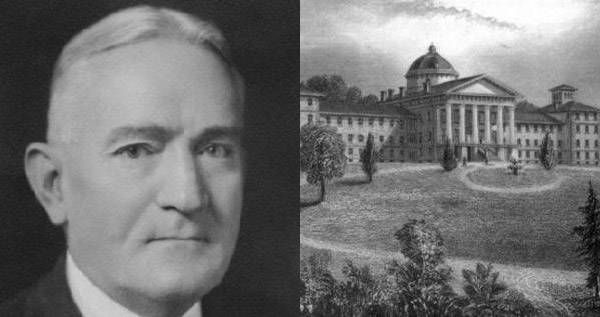
#10: Dr. Henry Cotton’s Surgical Bacteriology to Treat Mental Illness
In 1907, Dr. Henry Cotton, the unconventional director of an asylum for the mentally ill in Trenton, New Jersey thought that mental illness was caused by different parts of the body going wrong.
Often (without the consent of his patients) Dr. Henry Cotton removed teeth, tonsils, and other parts of his inmates’ bodies in an attempt to cure their mental problems.
#11: Dr. Lauretta Bender’s ECT and LSD Schizophrenia Experiments
A psychologist named Dr. Lauretta Bender had a theory that she could cure what was termed childhood schizophrenia in the 1940s.
Lauretta Bender administered electric shocks to the children’s brains before giving them an adult-sized dose of the psychedelic drug LSD.
She claimed great success with the experiments, though for some reason (!) this wasn’t carried out into the wider child and adolescent psychiatric treatment…
The 1940s had a lot of weird science going on! In another experiment to see if penicillin could cure the sexually transmitted disease syphilis, American scientists paid prostitutes to spread the disease in Guatemala.
Uncovered as recently as 2010, it is estimated that 1300 Guatemalans had been infected in the experiment.
The CIA got up to a lot of dirty tricks since it was first set up. For 20 years, the Central Intelligence Agency ran a medical program called MK Ultra, where they tried to find chemicals to control people’s minds.
The CIA had a range of goals with the program, which included giving foreign spies drugs to make them confess to what they had done, as well as chemicals that made people completely dependent on another and would do exactly what the other person told them to do.
Another experiment was to see if they could make enemy soldiers confused and disoriented without actually realizing they had been sprayed with the chemical.
The program was stopped in 1973. It isn’t known how many people were experimented on.
In 2006, the British spy agency MI6 paid out thousands of pounds in compensation to former soldiers, sailors, and airmen they had given weapons-grade LSD to without the military men knowing in the 1950s.
This came to light, and MI6 apologized for their sneaky psychedelic experiments.
#15: Porton Down’s Nerve Gas Testing on British Soldiers
In another set of experiments, the British government got soldiers to volunteer to be tested for what the soldiers were told was a “cure for the common cold.”
In fact, the hapless soldiers were videotaped while having chemical weapons tested on them, including Sarin nerve gas at the chemical warfare establishment in Porton Down, Hampshire.
Though most of them survived (with health problems), in one case, a soldier was killed. The inquest held in 2004 found that 23 additional servicemen were exposed to the nerve gas after that death.
With all the mistakes of the past, there are a lot of regulations on how medical experiments are carried out. Even so, they still go very wrong from time to time.
In 2007, after animal studies showed that the chemical TGN1412 was safe, they gave human subjects a dose containing 1/500th the amount they had tested on animals.
4 of the patients became seriously ill, displaying severe symptoms like projectile vomiting, uncontrollable bowel movements, and swelling of body parts.
It was later revealed that the patients were left with various life-threatening immune system deficiencies with multiple organ failure.
Even years later, they still suffer the negative health effects from the TGN412 trial.
When it comes to the largest empires in history, it’s important you first understand the definition of the word “empire”.
The word is simple enough. The Oxford English Dictionary defines it as “an extensive group of states ruled over by a single monarch.”
Simple enough, but it’s when you get to the politics and history that it can get a bit confusing. Does the United States of America have an empire?
Some people would say yes. What we today call China was once – like almost every recognized state on Earth – a collection of much smaller states that were conquered and subsumed into the whole.
What’s the original state, and what’s the empire?
And for that matter, what came first…the chicken or the egg???
Just kidding. I couldn’t resist.
Anyway, here are the ten largest empires in history, organized by their size at the height of their power!
#10: The Portuguese Empire
At 4.02 million square miles, nearly 7% of the world’s land surface, the Portuguese Empire ranks 10th of the largest empires in history.
The longest-lived of the European empires of the great age of discovery lasted for six centuries. It is called the first global empire, its conquests can be found in 53 modern sovereign states.
It grew by sea and reflected the Portuguese mastery of the waves during the 15th and 16th centuries, until the arrival of the Dutch and then the British as great maritime powers.
Finding itself at peace after long years of conflict in the early 15th century, the Portuguese – stuck at Europe’s western extreme – good only expand by sea.
Prince Henry the Navigator
First, they headed for North Africa, conquering Cueta in 1415. Prince Henry the Navigator helped inspire a push around the African coast, picking up territory as the explorers went south, until, in 1488, Bartolomeu Dias made it round the Cape of Good Hope, opening up the Indian Ocean.
Vasco da Gama landed in India in May of 1498, and two years later, Pedro Álvares Cabral, apparently heading for India too, landed in Brazil and planted a flag.
The Far East was next, with Malaysia reached in 1515, around the same time as China, where a trade deal for Macau was reached in 1557. Japan followed, where the Portuguese founded Nagasaki.
Brazil was so important to Portugal that the capital of the empire was briefly moved to Rio de Janeiro in 1815.
But by 1822, Brazil was independent, and attempts to exploit and expand their African possessions later in the 19th century was stymied by the growing British Empire.
António de Oliveira Salazar
After World War II, independence movements helped to sweep away Portugal’s remaining possessions. The right-wing dictator Salazar tried to cling on though – still keeping a seat in the national assembly for Goa until 1974, 13 years after India had claimed it as its own.
Today, the Azores, Madeira, and the Savage Islands are Portugal’s only overseas territory, though the Community of Portuguese Language Countries serves as a talking shop for former territories.
#9: The Abbasid Caliphate
With an area of about 4.29 million square miles, over 7% of the land on the planet, and around 20% of the world population, the Abbasid Caliphate was the world’s ninth-largest empire, surviving in some form from the eight to the 13th century and beyond.
The Abbasid Empire was a religious state, one of a succession of Islamic Caliphates which the modern militants of Islamic State would like to emulate.
Its rulers claimed direct descent from the Prophet Muhammad’s uncle Abbas. This, they said, was a closer tie than the Umayyad rulers they replaced. And, of course, they would be purer, better rulers.
They swept to power in 747, mobilizing 10,000 rebels under a black flag.
The Abbasids had support from non-Arab Persians (in modern Iran) and moved the empire’s capital to Baghdad to be closer to them. They set up the secular post of the vizier, a role that was to become powerful enough to reduce the Caliph to a ceremonial role.
The rule of the Abbasid is thought of as the Islamic Golden Age. The House of Wisdom in Baghdad was a world center of knowledge, welcoming scholars from around the world and translating many of the ancient Greek and Roman authors that would later inspire the European Renaissance.
Science blossomed, particularly medicine, and this is one of the greatest periods in Arabic literature, spreading on paper newly arrived from China.
While they were welcoming to international scholars and tolerant of non-Arab subjects, the Abbasid Empire saw the forging of an Arabic, Islamic identity.
The size of their territories would soon prove too much for the Abbasids, and even where the Caliph was recognized, independent states started to spring up in those places.
The Seljuk Turks threatened to overthrow the Caliphs, but they clung on.
They had no answer to the Mongols, who arrived in the Middle East in the early 13th century.
In 1258, Baghdad was destroyed by a Mongol army, and the Caliph was killed, wrapped in a carpet, and trampled by horses to avoid spilling his blood.
#8: Second French Empire
At 5.02 million square miles, some 9% of the world’s land area, the Second French Empire is the eighth largest empire in history.
It’s called the “Second Empire” to distinguish it from the earlier conquests, most of which, like Canada, had been lost by the time of Napoleon’s overthrow in 1814.
The Second French Empire’s most important possession was Algeria, conquered in 1830, and the independence of that country in 1962 is usually taken as the empire’s end. By 1938 around 110 million people were living in French governed territories.
European colonialists often carried moral baggage, along with their desire for raw materials, new and novel pleasures, and markets for their industry.
The French were no different, talking of a duty to “civilize the inferior races.”
Napoleon III reignited the nation’s love for empire, and France conquered territories in Africa and the Far East.
Senegal became something of a model for relatively benign occupation; slavery was abolished, and education, health, and agricultural reforms improved life for many people.
France had interests in China, Korea, and Japan, but its big territorial gain was in Vietnam. Catholic missionaries came first, and when they and their converts were oppressed, the troops started to arrive.
By 1864, Cochinchina the Emperor was forced to open treaty ports in Annam and Tonkin, and all of Cochinchina (as southern Vietnam was called) became a French territory in 1864.
France also had interests in Lebanon and Syria.
Emperor Napolean III
Napoleon III’s intentions for Algeria were good. He saw the country as a kingdom in its own right and its people as his subjects on something like the same terms as the French themselves were.
Algeria was the only French colony to see large-scale settlements.
Expansion in the South Pacific and Africa continued after Napoleon III’s downfall, and by the time of the First World War, France could call on large numbers of colonial troops, particularly from West Africa.
The largest extent of the empire was reached in 1938, just before its downfall in the Second World War.
As France was defeated by Germany, its overseas territories were lost to both Allied and Axis powers. After the war, imperialism was a fading force, and movements for self-determination were on the march.
Vietnam was humiliatingly lost by 1954, and a long, bloody, and vicious war that still plays a destructive role in French politics today was just beginning in Algeria.
By 1960, almost all the French overseas territories had been relinquished, and those that remained were considered overseas departments of France itself.
#7: The Yuan Dynasty
At 5.41 million square miles, 9.4% of the Earth’s land surface, the Yuans controlled 17.1% of the world’s population at their height in 1290.
If Yuan isn’t ringing any bells, you’ve certainly heard of Kublai Khan, the Mongol conqueror who adopted the name as he proclaimed his family a ruling Chinese dynasty.
Kublai’s grandfather Genghis Khan (literally, and almost correctly Ruler of the World) had stormed across Eurasia with his fearsome mounted horde amassing a vast territory that he divided between his sons and grandsons.
Kublai was to turn his inheritance into the Yuan Empire, the first foreign conquest of China in its history.
Kublai Khan came to his throne in 1260 and seemed set on expanding his territories across China. In 1271 he made his capital at Dadu, where Beijing now stands, and adopted the Yuan name.
Then, he set about removing the Song rulers from most of southern China.
In one of history’s longest and most famous sieges, Kublai imported military engineers from Iraq to destroy the Song’s great fortresses at Xiangyang in 1273.
By 1276, the Song were defeated.
How Did Kublai Khan Organize Mongol Rule in China?
Kublai Khan then set about becoming a Chinese ruler. The Mongol horde was fantastic at winning territory but had little successful experience of the boring, day-to-day business of government.
The Khan employed Chinese bureaucrats and did the last things you might expect of a Mongol ruler – he built thousands of schools, sponsored scholars and artists literally, and engaged in public works.
His territory stretched from Mongolia and Siberia in the North to the South Sea. Tibet was the south-western extreme of lands that stretched to the Xinjiang Province in the North.
Unified Yuan China prospered for a while with reformed and flourishing agriculture and industry. To the other descendants of Genghis Khan, however, Kublai was something of a traitor who was turning his back on his tribe’s traditional way of life.
Regular revolts were put down while Kublai was in power, but when his favorite wife and then his nominated heir died, he withdrew from public life in sorrow and died in 1294.
None of his successors were anywhere near as successful as the empire’s founder, and in less than 50 years, it was crumbling. The government coped poorly with a series of natural disasters, and some odd military decisions were made.
Emperor Toghun Temür weakened the central authority rapidly and retreated north back to Mongolia as Zhu Yuanzhang’s Ming forces approached.
By 1368, the Yuan era was finished, giving rise to the new Ming Dynasty.
#6: The Qing Dynasty
With 5.68 million square miles under its control (9.87% of the world’s land) the Qing Dynasty controlled the fifth largest empire in history. By population, with 36% of the world’s population in 1820, this empire is history’s largest.
The last hereditary Chinese dynasty was not established by China’s most numerous ethnic group, the Han, but was an arrival from the country’s North-East, where a Man leader (from Manchu) rose to replace the Ming Dynasty.
The Rise of Nurhaci
Nurhaci rose from minor tribal power via minor tribal disputes, first unifying his fellow Man tribes in 1582. In 1616, he was powerful enough to proclaim himself Khan, and a couple of years later proceeded to renounce his allegiance to the Ming dynasty.
He signed up Mongol allies for their military expertise. Han Chinese defectors started to join up, often tempted with the offer of Manchu wives.
On one particularly memorable occasion, a mass marriage united 1,000 couples simultaneously!
Nurhaci died before he could complete his conquest of China, but his successor Hong Taiji carried on his work, and the last Ming ruler, the Chongzhen Emperor, committed suicide in 1644 when Beijing was captured by another rebel general.
The Manchus arrived and proclaimed their dynasty when the Shunzhi Emperor was crowned “Son of Heaven” later that same year.
Qing Dynasty & the Manchus
The first 17 years of the Qing Dynasty rule were spent wiping out remaining Ming resistance and establishing a small ethnic minority as superior over a much larger population, often adopting Ming practices to ensure continuity.
It was not without problems. A 1645 order enforcing Manchu style haircuts (on pain of death!) was so unpopular that a bloody rebellion was put down with many massacres.
The Emperors Kangxi, Yongzheng, and Qianlong ruled over a Golden Age in the 18th century, with literature particularly flourishing.
Later rulers tended to be corrupt and internal strife was matched by the loud knocking of western imperial powers at China’s closed door.
Some attempts at reform were unsuccessfully made before Sun Yat-Sen’s 1911 revolution threw empires out of China for good.
#5: The Umayyad Caliphate Empire
The Umayyad Caliphate’s 5.79 million square miles of territory make it history’s fourth-largest empire. It grew from 661 to 750, when the Abbasids took its place. In its day, the Umayyad Empire was the largest the world had yet seen.
The Umayyads were a family from Mecca in modern Saudi Arabia, Islam’s holiest city. They took control of the Muslim caliphate in 661, using their descent from Muhammad’s grandfather as their claim to power.
Uthman Ibn Affan (644–656) was the first Umayyad caliph. His power base was in Syria, and Damascus was the Umayyad capital.
The history of the Umayyad caliphate is complex, wrought with tribal and personal rivalries, civil wars, and religious disputes.
It was an empire of expansion as well. After North Africa had been taken, Muslim rule was established in most of Spain, outlasting the rest of the Umayyad caliphate.
In 712, after expansion through central Asia, large parts of modern Pakistan were taken, but further expansion into India was halted.
The Byzantine Empire was an almost constant opponent. Rhodes and Crete were conquered, but attempts to take Constantinople never succeeded.
The Battle of Tours in 732 saw the Umayyad army halted by a Frankish force led by Charles Martel – it’s a battle that has been seen as having an epochal significance, guaranteeing Christian rule in Europe for centuries to come.
Fall of the Umayyad Dynasty
The Umayyad dynasty was ended by the Abbasid revolution. The new regime, under its black flag, wiped out most of the Umayyad family, massacring some after tricking them with promises of pardon.
The Spanish conquests remained the only surviving Umayyad territory.
The Umayyad dynasty was the first Muslim government in history to mint its own coins. They centralized and reformed the government, using a postal service that was very advanced for its time.
There were different rights for Arab and non-Arab Muslims and for non-Muslims, and these stresses contributed to the fall of the dynasty.
Their legacy includes the spread of Arabic as a language and some fantastic architecture, including the Great Mosque at Damascus and the Dome of the Rock in Jerusalem.
#4: The Spanish Empire
The Spanish colonial empire, with a territory of 7.49 million square miles, just over 13% of the world’s land surface, is the fourth- largest empire in history.
The Iberian Peninsula finally saw the end of centuries of internal rivalry and Moorish colonization in the 15th century. Like their neighbors, the Portuguese, the united Spanish kingdoms of Castille and Aragon started to look outwards.
Their first view was of the Atlantic and what might lie beyond the horizon.
The first great Spanish discoveries were those of Christopher Columbus, a Genoese sailor looking for a western route to the great riches of the east.
In doing so, he stumbled upon the West Indies, staking a claim for the Spanish crown that employed him.
Spanish Empire Expands to New Territories
An artistic rendering of the retreat of Hernán Cortés from Tenochtitlán, the Aztec capital, in 1520. The Spanish conquistador led an expedition to present-day Mexico, landing in 1519. Although the Spanish forces numbered some 500 men, they managed to capture Aztec Emperor Montezuma II. The city later revolted, forcing Cortés and his men to retreat.
The Spanish quickly expanded their territories. Arriving on the South American continental mainland and establishing their control over the West Indies by 1515.
By 1521, they had defeated the Aztecs in Mexico. Guatemala and Nicaragua were added by 1526. The Inca were overthrown in Peru in 1533, and by the 1540s, Chile was being added to the Spanish Empire.
In Europe, dynastic marriages put soon-to-be Holy Roman Emperor Charles V on the Spanish throne in 1516. In fact, Charles was the first King of Spain, uniting the kingdoms of Castile, Leon, and Aragon under the same crown.
Charles’ Hapsburg inheritance was vast (as was his jaw), including territories in the Low Countries, Italy, and central Europe. Spain was now undoubtedly the world’s superpower.
The Seven Years War, which ended in 1763, helped Spain get its hands on what was called the Louisiana Territory from France. It held it until 1800.
In Africa, there had been Spanish territories since 1497. Many were lost to Ottoman and related forces from the 16th century.
Fall of the Spanish Empire
The sun started to set on the Spanish empire as Britain rose to replace it. The Battle of Trafalgar in 1805 is marked as a defeat for Napoleon, but his Spanish allies lost most of their fleet, and with it, the ability to administer and defend their far-flung territories.
Napoleon’s subsequent invasions of Spain fatally weakened the central power. Independence movements in Latin America, many of them interested in reforming the Spanish monarchy too, started to make headway.
Spain’s vast South, Central, and North American territories set out on their own – Argentina in 1810, Paraguay (1811), Uruguay (1815), Chile (1818), Peru (1821), and so on.
The vast Spanish Empire has left a lasting legacy. Spanish is still the second most widely-spoken language on the planet, and Spanish-style Catholicism marched along with it.
#3: The Russian Empire
Now let’s say privyet to the famous Russian Empire! The Russian Empire’s area of 8.8 million square miles and a population of 176.4 million people in 1913 make it history’s third largest empire.
The foundation date of the Russian Empire is disputed, but Peter the Great’s declaration of empire following the defeat of Sweden in 1721 is an often-cited founding point.
The Great Northern War gave Russia access to the Baltic Sea and large territorial gains. Peter built his new capital, modestly named St Petersburg, in his new lands.
Further expansion into the Persian-held Caucasus followed before Peter died in 1725.
The only overseas territories of the empire were discovered in the 1740s as Russian traders and explorers established colonies in America, most notably Alaska (which was sold to the United States in 1867) but also in California and Hawaii.
Catherine the Great, from 1762, also added to Russian territory at the expense of the Polish-Lithuanian Commonwealth. She then took on the Ottoman Empire to win for Russia a Black Sea border and established control over Georgia.
Alexander I added Finland, a Bessarabia, to a nation that was now recognized as a major European power.
Napoleon’s misjudged invasion of Russia ended his empire and put Tsar Alexander I in a powerful position at the Congress of Vienna, which divided France’s territory and redrew the map of Europe.
Russia was about to add Poland to its many domains.
The Persians fought again in 1826, and Armenia, Nakhchivan, Nagorno-Karabakh, Azerbaijan, and Iğdır came under the Tsars of St Petersburg.
Despite its military confidence, Russia was still backward by European standards. While the countries of Western Europe went through industrial revolutions, Russia’s economy remained agrarian, and serfs (near slaves) were not liberated until 1861.
Great social forces were starting to move, while Russian troops kept marching on. They succeeded in taking Outer Manchuria from China by 1860.
The last Tsar, Nicholas II, failed to react to a changing world. Russia’s long-delayed industrial revolution was creating an unhappy army of urban workers.
When the Russian imperial steamroller finally hit the buffers, it was devastating. The Russo-Japanese War of 1904-05 was a humiliating disaster and was just one trigger for a domestic revolution that saw Nicholas making some concessions towards democracy.
If the Russo-Japanese war had shaken the empire, World War I crushed it. Russia’s military now discovered what the rest of Europe had been up to.
Russia Leaves WWI
The “Russian Juggernaut” of an almost endless supply of poorly trained manpower that had been invincible for so long collapsed going head-to-head against the machine gun, and the other technological advancements of the battlefield.
In 1917, the German enemy chose to help a former revolutionary return from exile. His given name was Vladimir Ulyanov, though he was better known as Vladimir Lenin.
The Tsar was overthrown in 1917, and then the Bolshevik socialist party seized power when Lenin encouraged an insurrection against the provisional military government that had replaced the fallen Tsar.
Russia quickly withdrew from the war, not because of a final military defeat – though that was probably coming – but because the empire collapsed from within following the rise of the Bolshevik party.
#2: The Mongol Empire
The 12.74 million square miles of the Mongol Empire makes it the second-largest empire in history and the largest contiguous land empire ever.
More than a quarter of the population of the world was living under Mongol rule at the height of the empire’s power in the 13th-century.
It is an extraordinary, even implausible, story of how nomadic tribal horsemen poured out of their homelands in every direction, compiling an astounding list of victories and a mind-boggling amount of territory.
From 1206 to 1260, the Mongols were never stopped on the battlefield – defeats were inevitably followed by a stronger, vengeful return.
Genghis Khan was the driving force behind this aggressive, expansionist explosion. He united the Mongol tribes, not without much blood-letting, taking the title Genghis Khan or “universal leader” along with his new power.
It’ll be no surprise to learn that Genghis set about a massive military reform program to create a disciplined, organized army. Now some of the best cavalry warriors on the planet had the potential to be world-beaters.
It might be more of a surprise to learn that he allowed freedom of religion in his domains, recognized the importance of trade, exempted the poorest from taxation, and encouraged literacy.
These reforms were vital to ruling a vast empire.
Genghis’ armies were soon on the march in all directions – in China, Tibet, Central Asia, Russia, and the Caucasus. No one could match them.
By the time Genghis Khan died in 1227, the Pacific Ocean had lapped on the eastern shore of his territories and the Caspian Sea on the western.
His nominated successor Ogedei simply picked up the baton, and the empire continued to grow, into China, Korea, and Persia and further west towards Europe.
Close enough for the Pope to send an envoy to the conquered territories in Russia, where he discovered a picture of devastation.
European history might be very different had Ogedei not died in 1241. Mongol armies were charging into Europe and were poised to take Vienna when the Khan died.
Mongol tradition called for a great council, so the army returned to the east to help elect a successor.
In 1258 the Abbasid Caliphate was toppled by the Mongol capture of Baghdad, and Mongol horsemen rode on into the Middle East, joined in anti-Muslim alliance by subdued Crusader kingdoms.
The western expansion of the Mongol Empire was halted at Ain Jalut in 1260. Mamluks from Egypt, a truce temporarily agreed with their Crusader neighbors, defeated the Mongols, in part thanks to the pioneering use of black powder weapons.
For once, the Mongols did not return in greater numbers.
The empire’s only apparent weakness was its regular succession disputes. Kublai Khan only took power after a long civil war.
Once in charge, he managed to set up complete Mongol rule of China, naming his ruling family the Yuan Dynasty, the first non-Chinese rulers of China.
The sheer size of the Mongol territories meant it split into competing territories ruled by four Khans. The Black Death wiped out millions and strained the empire’s stretched communications, and new powers started to rise as Mongol power declined.
#1: The British Empire
With a land area of 13.01 million square miles, 22.63% of the Earth’s surface, the British Empire is the largest empire in history. Around 1938, 20% of the world’s population lived in the British Empire.
That the once-tiny island of Britain should attain such power is perhaps as extraordinary as any of the stories here.
The British Empire was the last of the great empires (claims of American imperialism aside), and its legacy is still very much with us today: in the prevalence of English as a global language, in British-style institutions around the world, and in lines drawn on maps in London that are now hotly disputed.
The first colonies of the empire were won, while mainland Britain was still divided between England and Scotland.
England’s adoption of the Protestant religion put it at odds with Catholic Spain, Europe’s dominant power in the 16th and 17th centuries, with its own growing possessions in the Americas and Africa.
English privateers – legitimized pirates – attacked Spanish ships and ports but weren’t yet seeking to establish land settlements. That was happening closer to home, though, where English Protestants were settling in Ireland.
Elizabeth I granted the first patents to set up overseas colonies, and Sir Walter Raleigh landed in North Carolina in 1584.
Once peace with Spain had been concluded in the early 17th century, the speed of American and Caribbean expansion soon stepped up.
A series of Anglo-Dutch wars failed to establish English dominance of the sea but did open the door to further American expansion.
Much of the early British Empire was won by semi-private companies. The most famous is the East India Company, but the Hudson’s Bay Company took Canada, and the Royal African Company started to ship slaves from Africa to the West Indies.
Scotland’s South American colonial adventure in Panama collapsed disastrously, and the financial consequences were a major spur to the unification of the two kingdoms in 1707.
When William of Orange, the Dutch ruler, was invited to take the British throne in 1688, rivalry with the Netherlands was settled – the Dutch kept the spice trade, and the British took the textile trade that would soon play a crucial role in the rise of the Industrial Revolution.
The War of the Spanish Succession gave Britain even more territories from the defeated French and Spanish empires, including Gibraltar, the gateway to the Mediterranean.
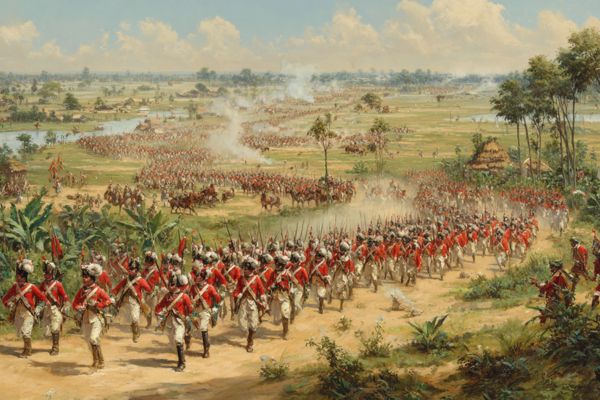
By the middle of the 18th century, Britain’s Indian possessions were growing at the expense of France. After winning the Seven Year’s War, the British also took Spanish and French possessions in North America.
The 13 colonies of America rebelled and won independence, but trade between the new United States and Britain kept the money from the New World pouring into British banks.
When the US sided with France in the Napoleonic Wars, British attention in North America switched to Canada and globally towards the Pacific and Asia.
In 1770, James Cook claimed Australia for Britain. At first, it was a penal colony, but the discovery of gold made Australia vastly wealthy.
New Zealand also joined the British Empire during this time.
The end of the Napoleonic Wars in 1815 saw the start of yet another century of massive British expansion. No one could challenge the Royal Navy, and Britain was the world’s superpower and the global police force.
By 1914, 10 million square miles and 400 million people had been added to an Empire, connected by steamships and telegraph wires.
“The Sun Never Sets on the British Empire”
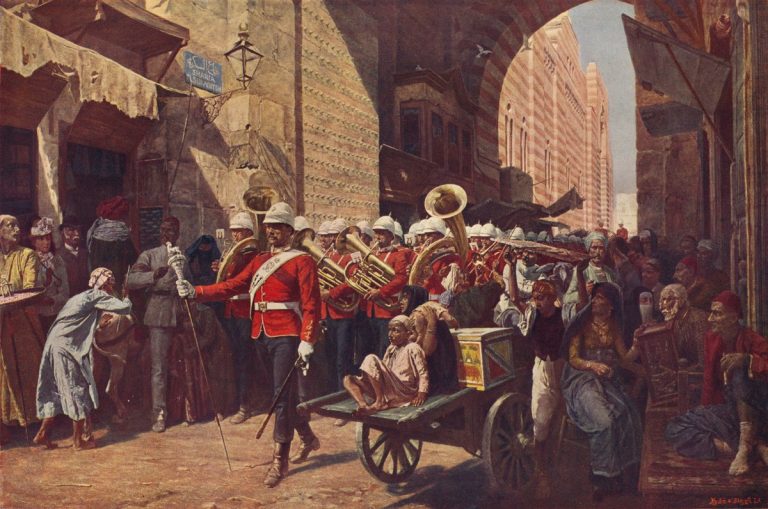
In 1858, India was taken from the East India Company to become the empire’s “Jewel of the Crown.” In Africa, South Africa was settled throughout the century, and Egypt was occupied in 1882.
Sudan soon followed, and the dream of establishing a north-south corridor from Cairo to Cape Town led to the birth of Rhodesia.
While the empire grew, the ties were loosening for white-settled colonies, Canada, New Zealand, and Australia, which were largely self-governed after 1907.
The First World War confirmed the push to the independence of these dominions, while troops and materiel from the empire were vital in defeating Germany.
The Treaty of Versailles pushed the empire to its greatest extent as Middle Eastern and African territories were granted to Britain.
The Age of Empire was coming to an end, however. Colonies were granted more and more freedom to govern themselves.
By 1926, the Balfour Declaration declared the nations of the “British Commonwealth of Nations” to be of equal status.
The Second World War was the final blow. Again, Britain’s overseas possessions were vital to support in beating Germany, but in a global war, it became apparent that Britain could no longer protect its empire.
There was a new world order with the United States and the Soviet Union as the two new superpowers, both of them anti-colonial.
In the decades following, Britain slowly withdrew from empire – often leaving bloody conflict in its place, not least in India and Pakistan and the Middle East, that we still live with today.
The handover of Hong Kong to China in 1997, the end of the 99-year lease, is often seen as the end of the British Empire.
Britain still has 14 overseas territories, and the Commonwealth of Nations comprises 53 states. Queen Elizabeth II is head of state of 16 countries, including Canada, Australia, New Zealand, and most of the West Indies.
Let’s be honest…everyone misses the ’90s. Even I (who was born in 1993, and only caught the tail end of it all) look back at the hilarious 90s slang terms in TV shows and just laugh my ass off.
The slang phrases that everyone thought was so cool back then seem just so ridiculous today.
And no, the irony is not lost on me that we came up with some pretty stupid slang phrases of our own in the 2000s as well…but that’s for another day and another random blog post!
For today, I thought I’d put together a compilation of my personal favorite ’90s slang terms for everyone’s amusement. I’d be lying if I said I wasn’t totally cracking up in my cubicle the entire time I was writing this.
To be honest, I’m amazed it’s taken me this long to put together a list of funny intramural basketball team name ideas.
I have always loved team sports, but I’d be lying if I said I didn’t enjoy coming up with zany team names just as much as I enjoy actually participating in sports or competitions.
These hilarious basketball team name ideas will have everyone laughing their asses off…until you start scoring and winning, that is. Without further ado, here are 24 funny intramural basketball team names for your team to use!
Funny Intramural Basketball Team Names List
1) The “Make a Swish” Foundation
2) The Block Party
3) The Rim Jobs
4) Everyone Hoops
5) Bank You Very Much
6) Radio Shaq
7) The Milwaukee Talkies (If you’re in Wisconsin)
8) Lebrontourage
9) I Know What Yao Ming
10) I Can’t Believe it’s Not Butler
11) Better Call Gasol
12) Rose Before Hoes
13) The Skyhookers
14) The High-Fivin’ White Guys
15) Duranting and Raving
16) Malone at Last
17) The Scottie Tip-ins
18) America Runs on Dunking(watch the copyright infringement on that one!)
19) The Play It Forwards
20) The Passholes
21) Raiders of the Lost Arc
22) The Magic Johnsons (You’ll get that one on the ride home)
23) The Slam I Ams
24)Tenacious D
Wrapping it Up
I had a really great time coming up with these funny intramural basketball team names, and I hope you had just as great a time reading them!
Ever heard of “The Millennial Whoop?” Probably not. I hadn’t until yesterday when I came across the term, realized it ranked well, researched it out of sheer curiosity, and decided to bust out an article detailing my findings.
And amazingly, no…”Millennial Whoop” was not my high school nickname. Let’s break this thing down!
What IS The Millennial Whoop??
The Millennial Whoop is actually a sequence of notes manifested as a particular tonal and lyrical pattern within a song.
You’d know it if you heard it- it sounds kind of like “Wa-oh, wa-oh”.
On paper, it’s between the fifth and third notes of the major scale and more often than not consists of consecutive eighth notes. It first came to prominence with the rise of 2000’s popular music hits.
Here’s what it looks like!
The two most obvious examples of the Millennial Whoop I could find were Carly Rae Jepson and Owl City’s 2012 hit “Good Time” and American Authors’ 2013 hit “Best Day of My Life”.
You can check out the clips below to hear it for yourself!
Whoop #1: Good Time by Carly Rae Jepsen (feat. Owl City)
Whoop #2: Best Day of My Life (American Authors)
Why the Millenial Whoop is a Thing
A study done earlier this year by the Ear Institutitute at University College London found that the human brain processes familiar tunes within 100-300 milliseconds.
Five male and five female subjects submitted their five favorite songs and were hooked to an Electro-Encephalography (EEG) imaging device.
And even though each subject only heard the equivalent of less than one second from a compilation of all their favorite songs in turn, their brains showed off-the-charts cognitive arousal and pupil dilation in response to this musical stimulation.
Although we as a generation are known for our tendency to constantly move around searching for better opportunities and seek out the next lifechanging experiences, the reality is that we have a weakness for nostalgia, for the familiar.
Studies have shown that human beings, in general, desire patterns to identify with. And what is a better example of modern identifiable patterns than pop music?
Much of today’s pop music hits are recycled, remixed, etc. It’s not difficult to see how we could subconsciously pick up on repetitive sequences in a musical culture that borrows from other previously successful hits.
The majority of the time, the Millennial Whoop is heard in upbeat songs that give us the opportunity to say, “Screw everything I can’t control…I’m going to cut loose, enjoy my life, and feel good listening to this song.”
As a result, this simple melodic sequence has become synonymous with positive feelings and an overall sense of well-being.
Music does soothe the savage breast, guys. For cereal.
42 Songs That Use The Millennial Whoop
The fact that the Millennial Whoop caters directly to the oft-repeated stereotype “All pop music today sounds the same” has done nothing to hinder the tremendous level of success that the millennial whoop has achieved to date.
I did some digging and grabbed 42 pop songs from 2000 and beyond on that feature the millennial whoop!
The Millennial Whoop has evolved into an integral form of self-expression for a new generation of music. We have drawn our fair share of criticism from older generations (particularly when it comes to the generational divide in the workplace) but I still personally consider the Millennial Whoop an upbeat audio interpretation of the carefree, idealistic and adventurous culture that is Millennialism.
The other night, I re-watched The Patriot, starring Mel Gibson. I love the movie itself- it’s massively entertaining, and Heath Ledger just kills his role in the film.
But as an amateur wannabe history buff, there were some significant historical inaccuracies of The Patriot that stood out.
While the costumes worn in the film, as well as the firearms used, are very accurate, many aspects of this film do not accurately portray characters or events that occurred before and during the American Revolution.
This article talks about what The Patriot got right, as well as what it got wrong.
#1: The Benjamin Martin Character
Fans of the film remember Mel Gibson’s admirable performance as Benjamin Martin, a South Carolina farmer and widower with seven children.
The film takes place in 1776 when the colonists of America were planning to go to war with England after years of oppression.
While the film was good at portraying key historical figures from the American Revolution, there was no such person as Benjamin Martin.
Benjamin Martin Character Inspirations
Francis MarionDaniel MorganThomas Sumter
Gibson’s character in The Patriot was influenced by a few famous figures: Thomas Sumter, Andrew Pickens, and Daniel Morgan- but it would appear the character is based most closely on Francis Marion (nicknamed “The Swamp Fox”), a Continental Army officer whose hit-and-run guerilla tactics in the South Carolina backwoods wreaked havoc on British supply convoys.
#2: The Depiction of the Col. William Tavington Character
Jason Issacs as Col. William Tavington
Now let’s examine the character of William Tavington. Tavington is a colonel in the notorious Green Dragoon Cavalry Unit of the British army, and the main antagonist in the film. He is the definition of ruthless.
At the beginning of the film, Tavington orders Benjamin Martin’s son Gabriel to be executed as a spy after Gabriel admits being the carrier of a dispatch note. When Gabriel’s brother attacks a soldier leading Gabriel away, Tavington shoots the boy without a second thought.
Tavington then orders Benjamin Martin’s house and barn burned to the ground because his family was tending both British and Continental soldiers in the aftermath of a battle that took place nearby. He says, “Let it be known that if you harbor the enemy, you will lose your home.”
Later, in a massive punitive campaign, Tavington and the brigade ride into the town that supplies the local colonial militia (led by Benjamin Martin) and gathers the citizens into the church.
He addresses them, saying that if they give him the location of the militia, the town will be left unharmed.
However, once he is given the location, Tavington orders the doors barricaded and proceeds to burn the church to the ground with all the townsfolk trapped inside.
Col. William Tavington Character Inspiration
The William Tavington character is based on a real Green Dragoon colonel that was stationed in the colonies during the Revolution- Col. Banastre Tarleton.
The real Col. Banastre Tarleton
Like Tavington’s character in the film, Tarleton did use brutality against the Americans during the Revolution and was known to have scoffed at the more moderate methods of his commanding officer, General Charles Cornwallis.
However, while there were a few instances of alleged brutality on Tarleton’s record, such as the killing of a unit of Militiamen that were trying to surrender (although Tarleton’s and several other accounts stated that somebody’s musket accidentally discharged, killing Tarleton’s horse and taking him down…which made his men think that someone had shot their commander while pretending to surrender), William Tavington and his Dragoons are portrayed as bloodthirsty renegades that indiscriminately murdered civilians and burned down private properties.
This was not the case.
How the British Army Acted While in the Colonies
Evidence given by Robert A. Gross, author of The Minutemen and Their World, shows that in fact, this brutish behavior by the British army was the opposite of how they actually carried out their duties.
Gross states that the British were quite civilized toward the citizens during their time in the colonies.
“Many Regulars were equally conscientious when they entered private homes. Famished after a long night’s march, they asked for refreshments and generally insisted on paying their hosts. Colonel Barrett’s wife, Rebecca, at first refused compensation: ‘We are commanded to feed our enemies’. But when the British officers threw money in her lap, she sourly accepted it.” (Gross, 121).
Another example Gross gives is an instance in which Timothy Wheeler, a sympathetic figure and supplier to the colonial militia in Concord, was stopped by a British officer demanding entrance to his storehouse (where Wheeler had stored many bags of flour meant to go to the militia), Wheeler aptly handled the situation, and the British officer was courteous.
“Wheeler readily let him in. Playing the ever-cooperative country bumpkin, Wheeler put his hands on one of his own barrels and explained, ‘This is my flour. I am a miller, Sir. Yonder stands my mill. I get my living by it…this is my wheat, this is my flour, this is my rye; this is mine.’ ‘Well’ he was told, ‘we do not injure private property’.” (Gross, 121).
#3: The Depiction of the Lord Charles Cornwallis Character
Tom Wilkinson as General Charles Cornwallis
Yet another inaccuracy in The Patriot was the depiction of the British General Charles Cornwallis. Cornwallis is depicted as a callous man, living the life of luxury within the American Colonies while his men were engaged in battle.
Cornwallis is seen as having the finest of everything and is considerably vain in regards to his appearance.
He is also quite materialistic; in one memorable scene, he demands one of his officers to know what has become of his formal wear that he had sent to England.
The officer replies that the ship has arrived, but as the ship is also loaded with supplies for the English soldiers, his men thought it best to unload that first.
Cornwallis is visibly infuriated by this.
Lord Charles Cornwallis Character Inspiration
The character of Charles Cornwallis is actually more of an apt representation of British general John Burgoyne.
General John Burgoyne
Ordered to lead his Canada-based army into New England to divide the colonies and end the war, Burgoyne failed in his campaign due to his many possessions causing his army to move at a ridiculously slow pace.
Had he moved a little bit faster, he might have given the British an easy victory!
#4: The Story of “Fort Wilderness”
The backstory of Benjamin Martin and his apparent combat experience was not immediately revealed, despite multiple allusions made by other characters throughout the film.
Eventually, Benjamin Martin explains to his son Gabriel that during his time in the British army (serving in the French and Indian War) enemy French and Cherokee forces surrounded English settlers, who fled for the refuge of Fort Charles.
According to Martin, by the time his unit reached Fort Charles, the enemy had gone. They left behind only the mutilated corpses of the English settlers.
When Martin’s unit caught up to the enemy at a place called Fort Wilderness, they captured the enemy forces and slowly and deliberately cut them apart.
The British army sent the heads of the dead French soldiers to Fort Ambercon, and then sent the tongues and the rest of the severed body parts to the Cherokee.
Because the Cherokee broke their treaty with the French not long after that, Martin and the rest of his unit were hailed as heroes.
The Story’s Accuracies:
In 1757, French and Indian forces took the British-held Fort William Henry. The Indians ended up slaughtering about 150 British soldiers, in clear violation of the terms of the British surrender.
This is probably the only historical account of the French and Indian War that bears any resemblance to Benjamin Martin’s Fort Wilderness tale.
The Story’s Inaccuracies:
Fort Wilderness was not a British military installment during the French and Indian War. It’s a resort and campground located within Disney World
Fort Charles is located in Port Royal, Jamaica
Wrapping it Up
Overall, The Patriot was a great movie. It was very accurate in terms of the politics portrayed within the film, particularly the reactions of the citizens in 1776 when voting to go to war.
Although many of the colonists, particularly Bostonians, had had it with the British by then, many others were in no hurry to take up arms against the Mother Country and her massive empire.
Benjamin Martin’s initial reluctance to support war with England was not uncommon at that time. Many colonists still considered themselves British subjects and did not want to go against the King’s army. This was something that Roland Emmerich, the director of The Patriot, managed to capture quite well.
However, many things, such as William Tavington and the British army’s brutality toward colonial citizens, were the creation of Hollywood. Therefore, while The Patriot is definitely worth watching, one should not take all events and characters within the film as absolute historical fact.